please look at these points of interets. ....
http://www.travelchannel.com/interests/cruises/photos/best-ports-of-call/page/5
Friday, January 13, 2017

Thursday, January 12, 2017
Visitors to the Petite-Patrie neighborhood northwest of Montreal’s city center previously had little reason to venture beyond the Marché Jean-Talon, a popular food market stocked with local bounty: seasonal produce, Quebec cheeses, canned maple syrup. After all, the area’s main commercial artery, Plaza St.-Hubert, is a bizarre strip of formal-wear shops touting bargain-basement prices on ’80s-style prom and wedding gowns (and the requisite underpinnings). But lately, amid the sequins and satin, a growing roster of cool cafes, coffee shops, bakeries and bars, many on residential side streets, has unexpectedly bloomed in this transforming neighborhood, which now attracts Montrealers from across the city.
Montréal Plaza
Montreal’s food world was skeptical when the renowned local chef Charles-Antoine Crête announced that his first solo venture would be on Plaza St.-Hubert. But this bustling brasserie
has been reliably packed with diners devouring platters of oysters and creative dishes like baloney cannelloni.
6230, rue St.-Hubert; 514-903-6230; montrealplaza.com.
Friday, December 30, 2016
Enlightened serendipity
If you want to feel enlightened, go to Sri Lanka.
But first, prepare to be humbled.
Sri Lanka simultaneously exalts and surprises, its attractions often so stunning one can't believe they're not better known: Outstanding ruins on a grand scale. A cultural blend that exists nowhere else on Earth. Artistic traditions that not only produce dreamy and mystical imagery but incredible modern architecture.
Perhaps for Americans, some lack of familiarity with Sri Lanka's offerings will soon dissipate. Europeans and Australians embraced the country soon after its 25-year civil war ended in 2009, and together those source markets account for almost 45% of all arrivals.
Americans represented less than 5% of the arrival total in 2015, but that's a 16% rise over the previous year. Sri Lanka in 2016 appeals to American early adopters, those in the first waves of travelers who reached Myanmar, Vietnam and Bhutan when those countries opened up.
But there is a difference: Pioneering Americans who traveled to those destinations in their early stages often found only standard accommodations at best; in Sri Lanka they'll find upscale hospitality companies, including luxury brands such as Aman, Taj and Anantara, as well as inspired homegrown resorts and hotels.
For the time being at least, they're also likely to find they're the only Americans in residence at some of those properties. And that may be the case for some time to come; the biggest barrier preventing Sri Lanka from growing its American arrivals significantly is distance, and that isn't going to change. There are no scheduled nonstop flights between North America and Colombo, its capital and largest city.
In fact, many Americans going there now were already in the neighborhood, tacking Sri Lanka onto a trip to India.
The good news for those who combine these two destinations is that as wonderful as India can be, Sri Lanka won't suffer in comparison. There are some similarities beyond a shared love of curry, cricket and kites, but the country is much smaller and less densely populated than India, and it has an identity and culture that are strikingly distinct.
But first, prepare to be humbled.
Sri Lanka simultaneously exalts and surprises, its attractions often so stunning one can't believe they're not better known: Outstanding ruins on a grand scale. A cultural blend that exists nowhere else on Earth. Artistic traditions that not only produce dreamy and mystical imagery but incredible modern architecture.
Perhaps for Americans, some lack of familiarity with Sri Lanka's offerings will soon dissipate. Europeans and Australians embraced the country soon after its 25-year civil war ended in 2009, and together those source markets account for almost 45% of all arrivals.
Americans represented less than 5% of the arrival total in 2015, but that's a 16% rise over the previous year. Sri Lanka in 2016 appeals to American early adopters, those in the first waves of travelers who reached Myanmar, Vietnam and Bhutan when those countries opened up.
But there is a difference: Pioneering Americans who traveled to those destinations in their early stages often found only standard accommodations at best; in Sri Lanka they'll find upscale hospitality companies, including luxury brands such as Aman, Taj and Anantara, as well as inspired homegrown resorts and hotels.
For the time being at least, they're also likely to find they're the only Americans in residence at some of those properties. And that may be the case for some time to come; the biggest barrier preventing Sri Lanka from growing its American arrivals significantly is distance, and that isn't going to change. There are no scheduled nonstop flights between North America and Colombo, its capital and largest city.
In fact, many Americans going there now were already in the neighborhood, tacking Sri Lanka onto a trip to India.
The good news for those who combine these two destinations is that as wonderful as India can be, Sri Lanka won't suffer in comparison. There are some similarities beyond a shared love of curry, cricket and kites, but the country is much smaller and less densely populated than India, and it has an identity and culture that are strikingly distinct.
Monday, December 12, 2016
PHOTO: River cruising on the Danube in Durnstein, Austria. (Photo by Janeen Christoff)
Pick Your Passion. There are so many river cruises from which to choose, pick one that focuses on something you love such as castles on the Rhine, a wine-themed cruise or bring the kids on a family-friendly Christmas markets sailing. You will love your cruise that much more when you are combining it with something that you are passionate about. River cruising is one of the breakout stars in travel for 2016 and there are more ways than ever to experience rivers around the world onboard any number of ships. However, there are a few tried and true tricks to making your river cruise experience a success and to fall in love with this mode of travel that can take you around the world. Here are five ways to enjoy the journey.
Prepare Your Appetite. River cruising is not about all-you-can-eat buffets and gorge-yourself dining — but there is a lot of eating. From five-course meals to cultural cuisine to tasting all of the different varieties of wine in a region — you should come prepared to enjoy the food. Don’t worry about the calories. You are sure to walk those off later on.
For those with special dining needs, onboard chefs on every cruise line are happy to accommodate with special meals to make dining a relaxing and fun experience for everyone.
For those with special dining needs, onboard chefs on every cruise line are happy to accommodate with special meals to make dining a relaxing and fun experience for everyone.
Immerse Yourself in Local Culture. The beauty of river cruising is that you get to see smaller towns and destinations that offer a glimpse into the everyday lives of local people in each of the countries that you visit during your cruise. If the ship docks in a small, river-side town that is used as a jumping-off place to explore a larger more popular destination, make some time to stroll the streets of the smaller towns and get to know what life in the country is really like.
Get ready to relax. The beauty of river cruising is that there is a lot on offer to keep you busy but one goal should be to clear some time to enjoy the cruise as well. Ditch a tour and stroll through town on your own. Spend some time on people-watching on the sun deck or swimming in the pool. Clear a few hours to play games in the lounge or enjoy a cocktail. Book a spa appointment instead of doing a walking tour.
While it is tempting, there’s no need to do all of the activities that are available or to over schedule yourself. Sit down with the cruise director and let them help you customize the cruise to be perfect for you. After all, that’s what they are there for.
Wednesday, November 30, 2016
Tuesday, November 29, 2016
Why Are The Azores The Next Big Travel Destination
Just like the myth of Atlantis, it’s time for the islands of Azores to rise and shine from its long sleep. Yap, they’re on track to become the next big travel destination!
The puzzled face of people when I say I’m from the Azores is a frequent dejà-vu in my life.
And I understand: for decades the islands has been under the shadow of other destinations and remained as one of the most exotic and remote places in Europe. Eventually the conversation reaches one question.
How is it like in your home island?
I like to answer back: How do you think it is? and find amazing how different can preconceived ideas on the exact same thing be.
Some people imagine Azores as the Canary Islands or even Malta: full of top-notch beaches and with warm dry climate all year. Nope. Others see it more like Madeira: flowers, impressive cliffs and hotels everywhere. Still very far away from the truth. Idilic rocky beaches like in some Croatian islands? *Wrong buzzer sound*.

Although I love how everyone thinks I come from some idyllic enigmatic place – wouldn’t mind to keep that mystery in the air -, I feel it’s about time to put some light on it once and for all, as I’m sure Azores can be the next big travel destination in Europe!
Where are the Azores?
Let’s start with the basics. Azores are a group of nine volcanic islands in North Atlantic ocean and a autonomous region of Portugal.
São Miguel is the biggest and most populous island (160,000 inhabitants) and also holds the largest city of the archipelago: Ponta Delgada.
They were first settled in the 15th century and today only 5-10% of the territory is build-up area, the rest is occupied by nature. The wild humid climate, dramatic landscapes, green pastures and fishing villages all result in a relaxing and remote-feel scenario. Excited already?
Azores map in the Atlantic
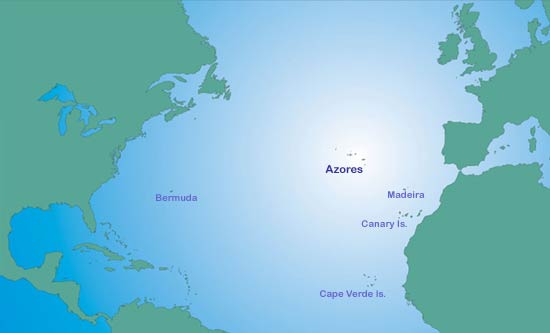
A common misconception is that Azores are “just off the coast of Portugal”. That’s what I grew up thinking too. But after taking several 2-hour flights to reach mainland Portugal, I started thinking either the airplanes were terribly efficient or I lived far more remotely than I imagined.
Turns out the islands are about 2/3 of the way between the U.S. and Europe, so I was pretty much based in the Atlantic ocean.
So… how are the Azores like?
For a start, just think of Azores as if like one day someone grabbed Iceland, moved it south – no ice anymore, just greenery – and smashed it in nine pieces in the middle of the Atlantic.
Let’s get more visual. The landscape is actually insanely green in different shades with hills, meadows and lush vegetation as the most striking features. The craters from several volcanos are now occupied by awe-inspiring blue lakes and lagoons creating quite eye-catching contrasts.
The super black igneous volcanic rock makes up all the coastline. Finally some spots of whitehere and there from the numerous Frisian cows (they compete with humans for the most populous animal in the islands).

I now have this mental exercise of trying to define random stuff in #hashtags (don’t ask). If I had to do it for the Azores it would be something like the following.
#nature #islands #volcanic #relax #green #cows
Apart from this nature-designed scenery that can (and will) step you back in time, the standard of living is not from decades ago. There are restaurants, spas, cafés and a wide range of supermarkets. And yes, computers, mobile phones and wi-fi connections are all available and DO work seamlessly. I would say living in one of the largest cities/villages is now equivalent to living in any european small-medium sized city.
Find out more information about the Azores on my micro-page about the islands. Climate info, best time to visit and much more for your perfect holidays!
Why you should go to the Azores
1. Nature. Nature. Nature.
For some reason Azores are constantly named as one of the most sustainable travel destinations in the world (they have actually reached the top spot in a couple of occasions).The best motivation to go to the islands is to be in direct contact with nature.

2. There’s a lot to do.
A few years ago Azores may have been a somewhat boring destination, but today there’s a tremendous potential in terms of activities to feed your adventurous and sporty side.
While they have always been sort of a diving mecca, they are now becoming increasingly popular for outdoor activities such as hiking, bird and whale watching and surfing. Here’s a quick introduction as what can you do in the island of São Miguel .
3. Kima.
If you ever are in the islands, you’ll see this name everywhere. Kima is a soft drink made from pulp of the passion fruit. It’s only available in the Azores so it’s a once in a lifetime opportunity to drink this nectar of the Gods.
Start your search for accommodation in Azores with my pre-selected list of hotels/guesthouses/villaswith wifi and best value-for-money relation in Booking!
4. The volcanic experience.
Due to its volcanic origin, across all islands it’s possible to find volcanic phenomena such as thermal baths, hot springs (the bathable ones) and hot hot springs (the ones you’ll get boiled alive). In Furnas, it’s even possible to use the energy of the planet to cook your lunch.
Also, beaches in Azores are slight different to what you might be used to experience, as the sand is of a dark grey colour – I’ve even had eeewww reactions when I shared this with some people. Seriously? Can’t understand why, golden beaches are so last century!


5. Four seasons of the year in just one day.
Yap. Even though the climate in Azores is tricky, don’t let it bring you down. The wind can get a bit crazy, it rains often and most importantly: the weather changes quickly and frequently. But that just adds to the thrill of it, right?

6. The timing of going to Azores couldn’t be better.
In my opinion, this is key, When I was living in Lisbon, in a very good day I’d get a return deal to Azores from about 200EUR. Two years ago I even paid 430EUR. Sure it was kind of a last-minute purchase – my fault for not complying with the buying airline tickets most basic rules – but still, paying that amount of money for a 2 hour-long flight is ro-bbe-ry.
So… what has changed?
Short answer: everything!
Long answer: Since March 2015, the air space in Azores has finally been liberalised, which means literally any airline company can now fly there. Ryanair and Easyjet have already regular routes from Lisbon, Porto and London (they’ve promised more routes).
Nowadays, flights can be as low as 30EUR. To cater this herd of new low-cost tourists, guesthouses, hostels and other cool accommodation as well as new creative tours/things to do have been popping out like mushrooms. All of a sudden, EVERYONE IS COMING!
Anyway the islands are still gaining momentum in their state of semi-discovery. Which means now it’s that sweet spot where the minimum amount of tourism offers and services are in place to get you the maximum experience exploring the unspoiled nature of the islands. Take advantage of it.
Friday, November 25, 2016
Inspirational Travel Quotes for the day!...:)
– “Fate is what happens to you…destiny is what you do with it.” –Best Exotic Marigold Hotel
– “Travel is fatal to prejudice, bigotry and narrow-mindedness.” –Mark Twain
– “One’s destination is never a place, but a new way of seeing things.” –Henry Miller
– “A traveler without observation is a bird without wings.” –Molish Eddin Saadi
– “All journeys hae secret destinations of which the traveler is not aware.” –Mark Buber
– “Not all those who wander are lost.” –JRR Tolkien
– “Once you have traveled, the voyage never ends, but is played out over and over again in the quietest of chambers. The mind can never break off from the journey.” –Pat Conroy
Subscribe to:
Posts (Atom)